
Fall Is Here: Two Lawns, Two Opposite Moves
Every September the same question shows up in my inbox, in the Facebook groups, and from the neighbor two doors down: “Should I fertilize my lawn this fall?”
The honest answer is that it’s the wrong question. It’s like asking whether you should wear a coat without saying where you live. The right question is what kind of grass you have, because the two families of lawn grass want the exact opposite thing in fall.
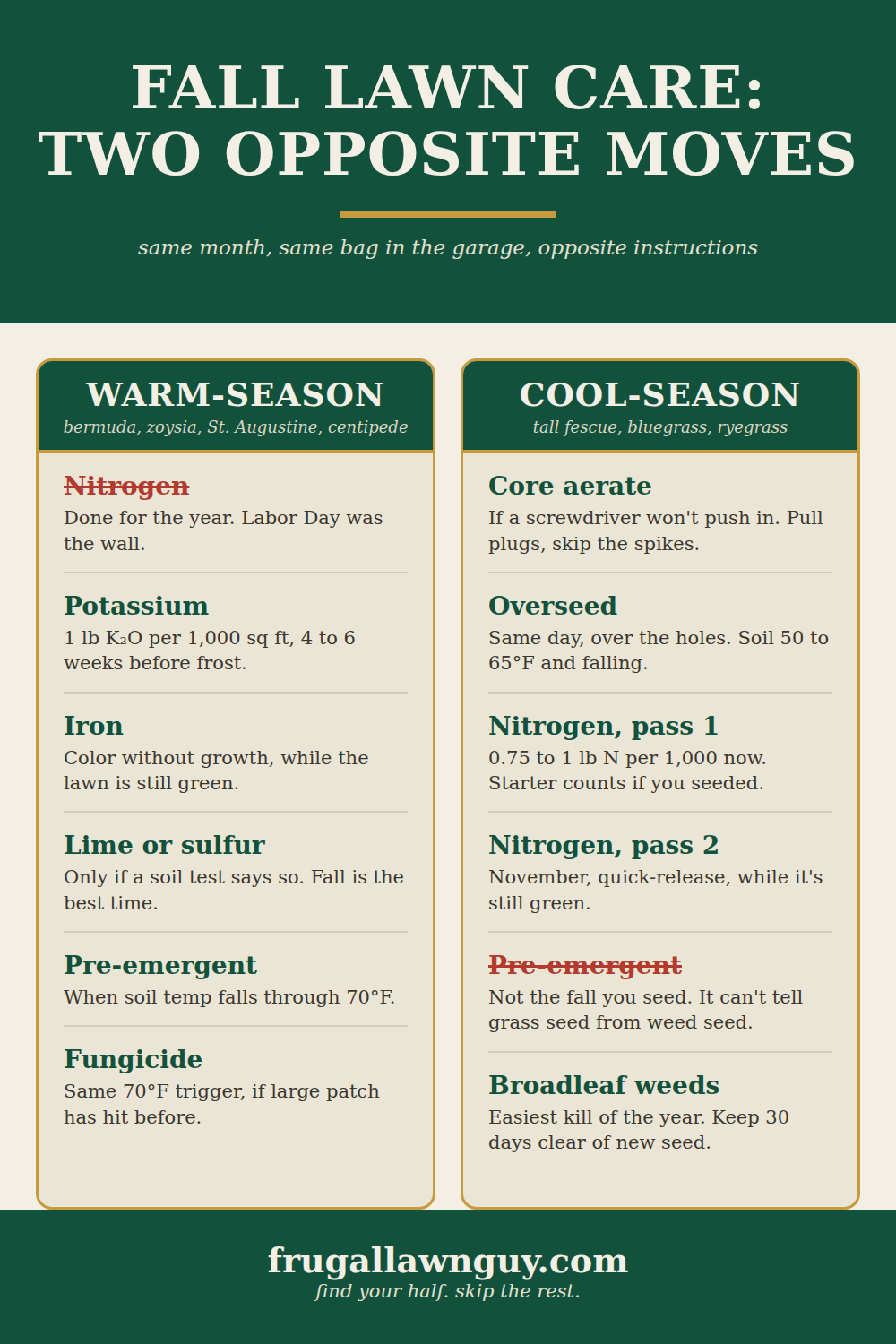
Warm-season grass (bermuda, zoysia, St. Augustine, centipede) is done with nitrogen for the year. Stop now, switch to potassium, get ready for large patch season. Iron, lime, and anything else your soil test calls for are all still fair game. Cool-season grass (tall fescue, Kentucky bluegrass, ryegrass) is walking into the most important six weeks of its year. Aerate if the soil needs it, seed it, feed it, and feed it again in November. Same month, same bag in the garage, opposite instructions.
Why the Calendar Flips
Warm-season grasses grow when it’s hot and shut down when the soil cools. Cool-season grasses do the reverse: they suffer through July and hit their stride in September and October when soil sits between 50 and 75°F.
So the thing that makes September a good month for one lawn is exactly what makes it a bad month for the other. A fescue lawn fed in September is banking density and root mass it will cash in next April. A bermuda lawn fed in September is growing soft leaf tissue right as the spring dead spot fungus starts infecting, and it will cash that in next April too, as dead circles.
I’ve run both. Years of bluegrass and fescue in New York, Massachusetts, Ohio, and Tennessee, and zoysia now in Peachtree City. The programs don’t just differ. They’re mirror images, and the fall is where the mirror is most obvious.
If You Have Warm-Season Grass
Stop the nitrogen. The last application should have gone down in late August. If it hasn’t, Labor Day is the wall, and past that you’re feeding disease, not grass. The full reasoning, including why the “six weeks before frost” rule everyone repeats is anchored to the wrong date, is in When to Stop Fertilizing Warm-Season Grass.
Switch to potassium. One pound of K₂O per 1,000 square feet, four to six weeks before your first frost. Sulfate of potash (0-0-50) at 2 lb per 1,000. Rates and where to buy it are in that same article.
Get the pre-emergent down. Poa annua and winter broadleaf weeds germinate when soil temps fall through 70°F, and for most of the South that’s mid-September to early October. Timing is in the fall pre-emergent guide.
Watch soil temp for large patch. When 4-inch soil temperature starts its decline through 70°F, that’s the fungicide trigger if your lawn has a history. Mine does, so the first application goes down the first or second week of October.
What You Can Still Do
Cutting off nitrogen doesn’t mean the program is closed for the year. Nitrogen is the one input that pushes soft top growth into disease season. Almost everything else is still on the table, and a couple of these jobs are better done now than in spring.
Some links on this page are affiliate links. If you buy through one, I may earn a commission at no extra cost to you. It doesn’t change the picks. How I choose products.
Iron, while the lawn is still green. Iron gives you color without the growth, which is exactly what you want in September. It only works on grass that’s actively growing, so this window closes when the lawn starts going off color for winter. Don’t spray it on dormant or drought-stressed turf. FeATURE is $26.17 at DoMyOwn as of October 2026. It does carry a little nitrogen (it’s a 6-0-0), but at an ounce or two per 1,000 that works out to under a hundredth of a pound. That’s not a feeding. Rates and the cheaper ferrous sulfate route are in the iron guide.
Lime or sulfur, if a soil test says so. Fall is the best time of year for both. Lime takes months to move pH, so what goes down now is working by green-up. Pull the sample first, and send it to your state extension lab. It runs about $10 in most states and it’s the most credible number you’ll get. My tests keep showing plenty of magnesium, so I use calcitic lime every time, never dolomitic. Pelletized calcitic is a $10 to $14 bag at the big box. High pH goes the other way with elemental sulfur, 5 lb per 1,000 max per pass. If you have centipede, don’t lime at all unless the test shows pH below 5.0. How to read the report is in the soil test guide.
Anything else the test calls for that isn’t nitrogen. Potassium is the obvious one and it’s already on the list above. Phosphorus or micronutrients, same deal, if the report shows a real deficiency. The catch is the bag. Most products with “fall” on the label carry nitrogen, so read the first number. For a warm-season lawn in September that number should be zero.
Once the lawn goes dormant, leave it alone. Brown is fine. Brown is what it’s supposed to do.
If You Have Cool-Season Grass
Aerate first, if the soil needs it. Push a screwdriver into moist soil. If it slides in with hand pressure, skip this and keep your money. If you’re leaning on it, rent a core aerator, the kind that pulls plugs. Spike tools and the sandals don’t count. They shove soil sideways and make the compaction worse. Aerate and seed the same day, straight over the holes, because those holes are where seed gets real soil contact. You need about four weeks of growing weather left afterward, so for most of the cool-season zone this belongs in late August or September. Details in the core aeration guide.
Seed now. Soil between 50 and 65°F and falling is the germination window, and you need the seed down at least six weeks before hard frost so it roots in. For most of the cool-season zone that’s mid-August through the end of September. The fall overseeding guide covers seed-to-soil contact, what to read on the label, and the one rule that costs people a whole bag of seed: don’t put down pre-emergent and seed in the same fall. It doesn’t know the difference between grass seed and crabgrass seed. If your lawn is already thick, skip the seed and go straight to feeding.
Feed it. Twice. Pass one in mid-September at 0.75 to 1 lb of actual nitrogen per 1,000. Pass two in early to mid-November at 0.5 to 1 lb, quick-release, near your last mowing while the lawn is still green. That’s the whole play, and it’s worth more than everything you do in spring combined. Rates, sources, and the math on which bag is actually cheap are in Cool-Season Fall Fertilization.
If you want the whole year on one page, the Cool-Season Rationalist Program lays out six soil-temperature-triggered rounds for about $200.
The Yard That Has Both
Plenty of transition-zone yards do: fescue in the shady back, bermuda in the sunny front. If that’s you, you are running two programs, and September is the month they diverge hardest.
The fescue gets seed and nitrogen. The bermuda gets potassium, maybe iron, and no nitrogen. Keep the spreader settings written down, because the mistake I see most is somebody running the fescue winterizer bag across the whole yard in one pass. On the fescue, that’s correct. On the bermuda, that’s the October application that shows up as dead spots in April.
The Bag in the Garage
That half bag of summer fertilizer is what starts most of these mistakes. It feels wasteful to leave it.
If you have cool-season grass, it’s probably fine for pass one. Check the first number, apply at the rate that gets you about 1 lb of N per 1,000, and you’re done. If you have warm-season grass, put it back on the shelf. It’ll be exactly as good in May, and May is when it belongs.
Want this sorted for your own lawn? The 7-question lawn plan matches your grass, your problems and how much effort you want to put in, then hands you the shopping list.
Quick Reference
- Warm-season (bermuda, zoysia, St. Augustine, centipede): nitrogen stops by Labor Day. Potassium at 1 lb K₂O per 1,000 four to six weeks before frost. Pre-emergent when soil falls through 70°F. Fungicide at the same trigger if large patch has hit before. Still fine: iron while the grass is green, lime or sulfur per a soil test.
- Cool-season (fescue, bluegrass, ryegrass): core aerate first if a screwdriver won’t go in, then seed the same day. Seed when soil is 50–65°F and falling. Nitrogen mid-September (0.75–1 lb) and again early-to-mid November (0.5–1 lb, quick-release). No pre-emergent the fall you seed.
- Both: soil temperature is the trigger, not the calendar and not the first frost date. Free lookup here.
Next Steps
Not sure which grass you have? Wide blades that go straw-brown in winter are warm-season; fine, upright blades that stay green through Christmas are cool-season. The warm-season schedule and the cool-season program will each take it from there.
This site uses affiliate links. They don’t change what I recommend. They keep the lights on here.