Lawn Topdressing and Leveling: How to Fix an Uneven Lawn Without Killing It
Your Mower Is Scalping the Same Spots Every Single Pass
You know exactly which areas they are. The low spot near the downspout. The dog divots from last summer. That slight ridge that leaves the deck chewing into the turf every time you turn. You’ve lived with them for a season or two because you weren’t sure what to do about it, and everything you’ve read either tells you to just buy sand and go, or buries the real process in so much hedging you still don’t know where to start.
The actual process isn’t complicated. But the order of operations matters, and two or three common mistakes will either waste your time and money or kill the turf you’re trying to improve.
Some links on this page are affiliate links. If you buy through one, I may earn a commission at no extra cost to you. It doesn’t change the picks. How I choose products.
The short shopping list: 48-inch double-sided leveling rake (~$49.99) · Dremmt 30-inch lawn lute (~$59.99) — the sand is the expensive part, not the tool. All picks and why.
Two Different Goals, One Word
Topdressing means applying a thin layer of material over an established lawn. That single definition covers two different goals that get confused constantly.
Leveling topdressing fills low spots, ruts, and surface irregularities. The goal is grade correction. Sand is the primary material because it’s dense, stable, and stays put once it settles.
Organic topdressing improves soil health. Introducing microbial activity, improving soil structure, reducing thatch over time. Compost is the primary material here. Sand does almost nothing for soil biology.
Sometimes these goals overlap. A 70/30 sand-compost blend addresses both simultaneously, which is why it’s often the best general-purpose option. But if your primary goal is leveling, don’t let the soil-health conversation steer you toward a material that won’t hold grade. And if your goal is soil improvement, a light compost dressing handles that better than any amount of sand.
Know which problem you’re actually solving before you order material.
The Timing Window
The best time to topdress is when your lawn is 100% green and actively growing. For warm-season grass in the Southeast, that’s May through August. June is solidly inside the window for Georgia and most of the region.
The reason isn’t arbitrary. Topdressing works by filling low spots and then letting the grass grow through the material. Rhizomes and stolons push upward, anchor it, and knit it into the surface. A half-asleep lawn doesn’t have the energy for that. The sand just sits there, holds moisture against the crowns, and in some cases smothers what’s underneath.
This is the same principle covered in the patience and timing article: the worst topdressing outcomes happen when someone acts on the calendar instead of on what the lawn is actually doing. Leveling on dormant or partially dormant turf is one of the most common expensive mistakes homeowners make.
Wait until the lawn has been mowed weekly for at least two to three weeks. That’s your signal it’s ready.
One caveat: if you’re seeing active large patch in your zoysia, brown rings with a yellow border, hold off until it clears. Don’t topdress stressed turf.
The Sand Controversy (Honest Version)
Clemson HGIC’s official guidance says don’t use sand to topdress if your native soil is clay or loam. Use topsoil or compost instead.
That concern is real, but it applies specifically to fine sand mixed into clay soil in high volumes. To meaningfully change clay soil drainage, you’d need sand to represent roughly 50% or more of total soil volume. A quarter-inch topdress doesn’t come close to that threshold.
The actual risk is using the wrong kind of sand. Fine, rounded sand, play sand, beach sand, anything marketed as smooth or silica fine, packs between clay particles and creates problems over time. Coarse angular sand, applied thin, doesn’t.
The correct answer for Georgia Piedmont clay:
- For leveling: coarse washed concrete sand or coarse masonry sand, 0.5–1.0mm particle size. Not play sand.
- For leveling plus soil improvement: 70/30 coarse sand-compost blend.
- For organic topdressing only: straight compost, no sand required.
At a big-box store: Quikrete All-Purpose Sand (Model 115251, ~$6–7 per 50 lb bag) is the right product. Quikrete Premium Play Sand (Model 111351) is not, the bags look similar and the prices are similar, but the particle size is completely different. Check the label. “All-purpose” and “commercial grade” are the words you want. “Play sand” or “smooth” are not.
Buy it: Quikrete All-Purpose Sand (50 lb bag), around $6–7.
For bulk orders, ask for washed concrete sand or coarse masonry sand, 0.5–1.0mm range. In the Atlanta area, River Sand Inc. (riversandinc.com) sells USGA-spec topdressing sand. GLM Landscape Supply and Georgia Landscape Supply both deliver to the metro area. Bulk typically runs $40–65 per cubic yard delivered, a fraction of bag pricing at scale.
The Application Process
Step 1: Mow Low
Drop your mowing height before topdressing. For zoysia, aim for 1–1.5 inches. For bermuda, 1/2–1 inch. If you’ve been mowing at 2.5 inches, take it down in two or three passes over several days. Lower turf height means the sand makes better contact with the crown area rather than just sitting on top of the canopy.
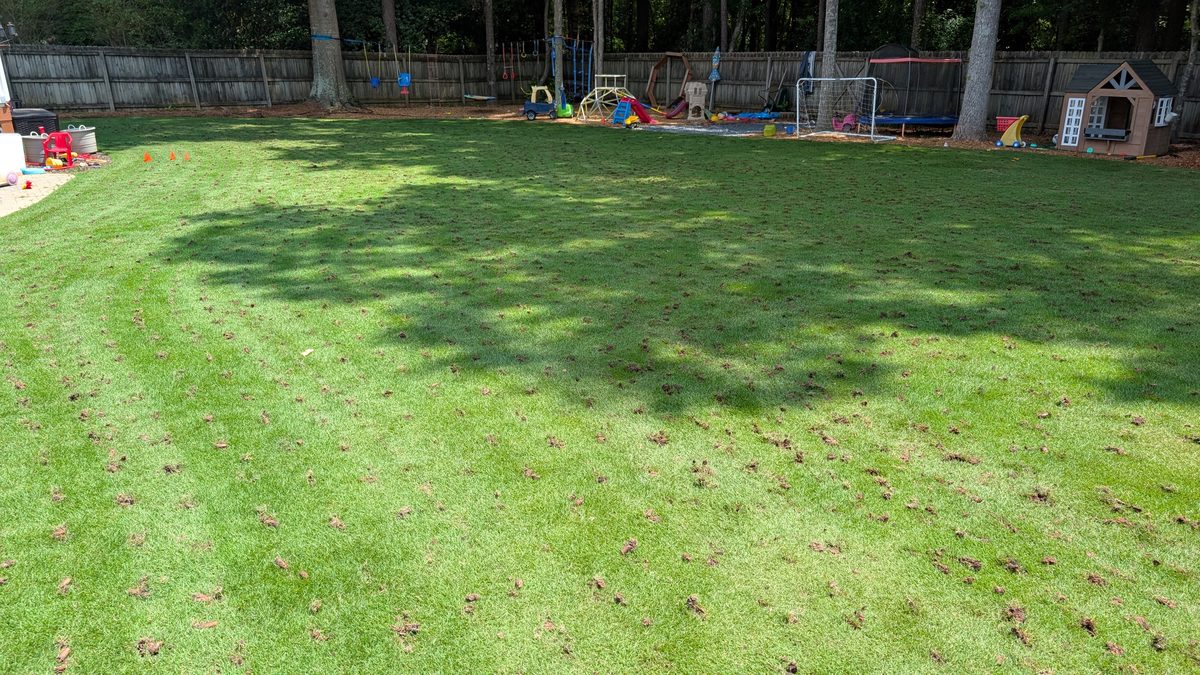
Step 2: Calculate Material
At 1/4-inch depth: lawn area (sq ft) × 0.0208 ÷ 27 = cubic yards needed
Quick reference:
- 1,000 sq ft: ~0.77 cubic yards (~42 fifty-pound bags)
- 3,000 sq ft: ~2.3 cubic yards (~125 bags)
- 5,000 sq ft: ~3.9 cubic yards (~210 bags)
- 10,000 sq ft: ~7.7 cubic yards (~416 bags)
For anything over 2,000 sq ft, bulk delivery is the clear economic choice. Bags cost $6–7 each; bulk runs $40–65 per cubic yard. On a 5,000 sq ft lawn, bulk saves roughly $900 over bags.
Step 3: Apply, Spread, Drag, Water, Mow
Maximum depth: 1/4 inch per pass for zoysia. Bermuda can handle 1/2 inch, but zoysia at 1/4 inch is the right conservative limit. After spreading and working in the material, you should still see green grass tips above it. If it looks like a sandbox, you’ve gone too deep.
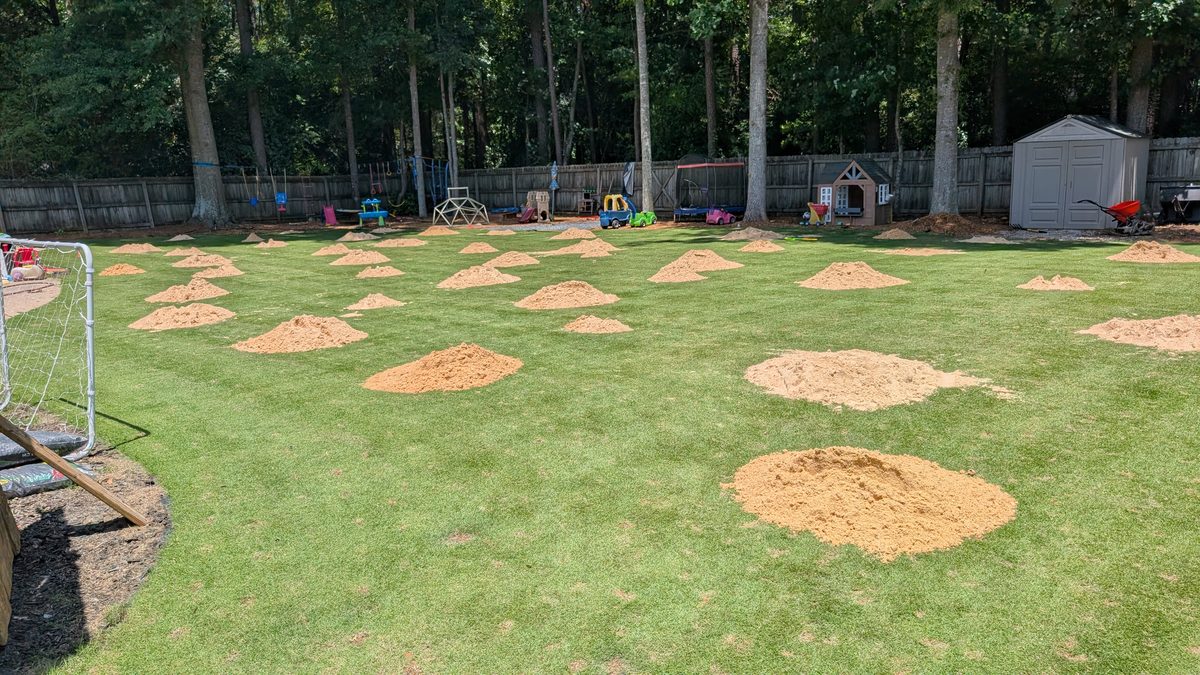
Apply by moving material across the lawn by wheelbarrow, dumping small piles every 10–15 feet. Work systematically.
Spread with a lawn lute. The lute is a wide, flat-head tool, typically 30–36 inches across, that bridges over high spots and deposits material into low spots. Use push-pull strokes in two perpendicular directions. A garden rake leaves ridges. A lute floats. This tool is the key to a smooth, even finish.
Drag a chain-link fence section (3×4 feet, pulled by rope) over the surface to work the sand down into the canopy. Almost free, and it works.
Water in lightly immediately after. 15–20 minutes of irrigation to settle the sand without washing it off the spots you just filled.
Wait 7–14 days before mowing. A light application of ammonium sulfate (21-0-0) a few days after topdressing helps push active growth through the layer faster.
Lawn Lute Options
Tier 1 (DIY): Back of a stiff garden rake to move material, then a chain-link drag mat for the finish. More labor-intensive, less precise, but it works and costs almost nothing beyond the sand.
Tier 2 (Mid-range, what I use): The 48″ double-side leveling rake (~$50) is what I run on my own zoysia. The 48″ width covers roughly 60% more area per pass than a 30″ lute, which matters when you’re moving sand across a full backyard. Double-sided: flat side for leveling, serrated side for working material into the canopy and breaking up small lumps. Comes with 20 marking flags for identifying low spots before you start.
Buy it: 48″ Double-Side Leveling Rake w/ 20 Marking Flags, around $50.
For a narrower lute on smaller or tighter areas: the Dremmt 30″×10″ (ASIN B0BZMXK6YL, ~$45–65) is full stainless, no flex under heavy sand, and the Gardease 30″×10″ (ASIN B0DR9H7WKD, ~$35–50) is the budget alternative in the same size class.
Buy it: Dremmt 30″×10″ Stainless Steel Lawn Lute, around $45–65.
Buy it: Gardease 30″×10″ Lawn Lute, around $35–50.
Tier 3 (Pro-grade): The Standard Golf Levelawn Pro 30″ (ASIN B000237ZMQ, $164.99 on Amazon as of Sept 24, 2026) is what golf course supers have used for decades. Stainless steel tray, 72-inch wood handle, built to last 20+ years. It’s an excellent tool. But the 48″ double-side rake covers more area for about a third of the money. The Levelawn Pro is worth it if you prefer the classic narrow-lute style or do this professionally. For the home program, it’s overkill.
Buy it: Standard Golf Levelawn Pro 30″, around $165.
Verify current Amazon pricing before purchasing, prices fluctuate.
For Severe Low Spots: The Step-Down Protocol
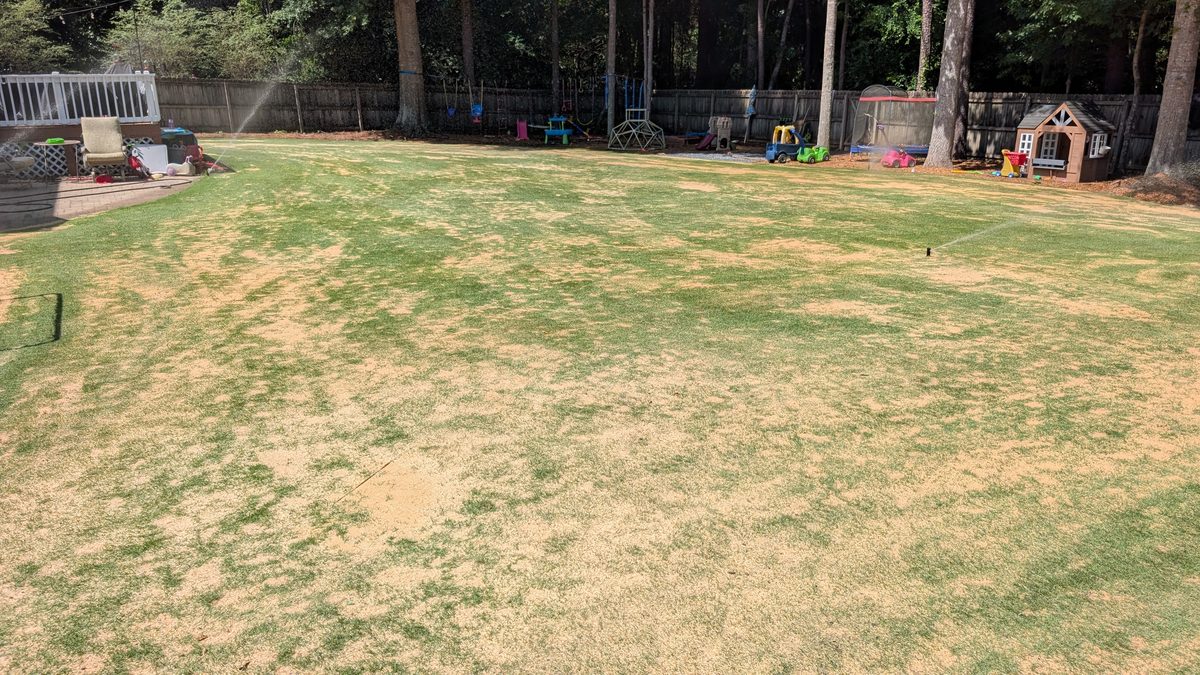
If a low spot is deeper than 1 inch, you can’t fix it in one topdressing pass without smothering the grass.
- Fill the depression with coarse sand or screened topsoil to within 1/2 inch of the surrounding surface.
- Wait for the grass to push through and show vigorous, full green-up, 2–4 weeks in June.
- Once fully green and growing through the first application, add the next 1/4-inch layer.
- Repeat until level.
Rushing this by dumping 1.5 or 2 inches at once smothers the turf. You end up with a dead patch that either needs re-sodding or takes the rest of the season to fill in from the edges.
For areas deeper than 2 inches: fill with screened topsoil, let it compact and settle for a few weeks, then address the remaining variance with topdressing. Depressions over 3 inches typically need digging out, filling, compacting, and re-sodding rather than topdressing.
If your uneven surface is the result of widespread compaction rather than specific low spots, aerate before topdressing. On Piedmont clay, annual aeration plus topdressing over several seasons is how you build a genuinely level, well-draining lawn.
Top 3 Anti-Patterns
Topdressing in fall. Warm-season grass heads into dormancy in September and October. Any sand you apply just sits there until spring, holding moisture against the crowns through winter. The grass can’t push through before it goes dormant. Fall is also peak large patch risk for zoysia, the wet conditions from topdressing are exactly what the fungus needs. Wait for the following June.
Using play sand. This is the difference between Quikrete Premium Play Sand (wrong) and Quikrete All-Purpose Sand (right), the bags look almost identical. Read the label every time. Fine rounded sand builds a dense, low-permeability layer over multiple seasons of application.
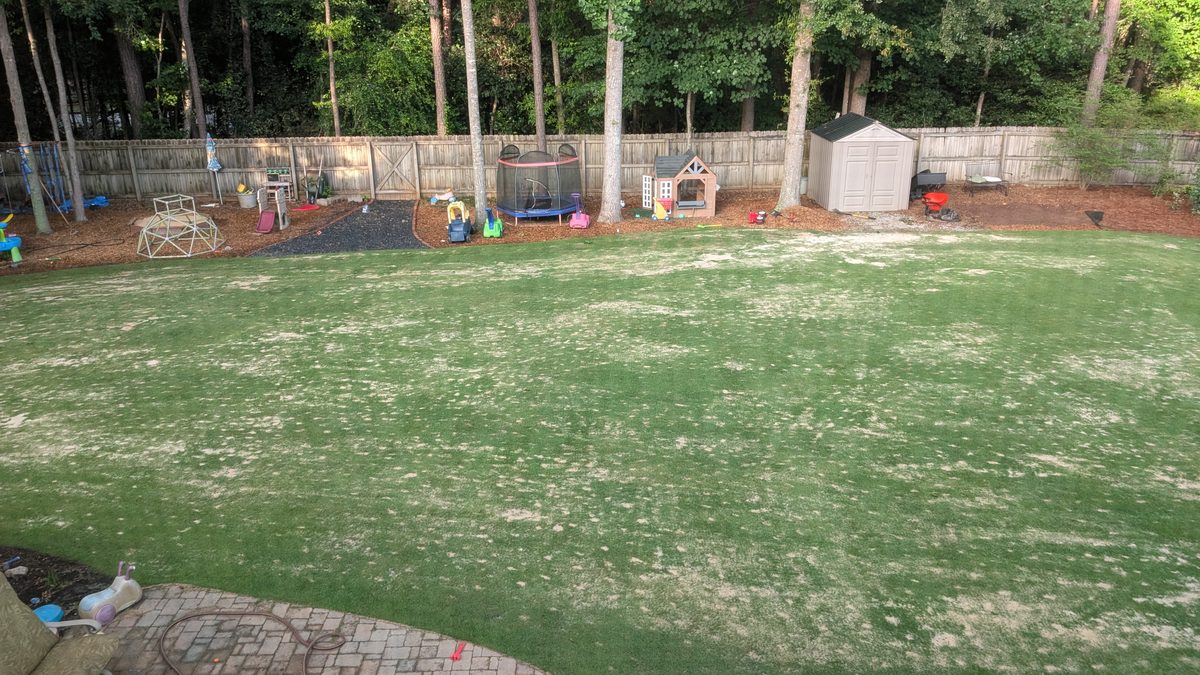
More than 1/4 inch in one pass on zoysia. A 1/2-inch application that bermuda recovers from in two weeks can sit on zoysia for six weeks, turning buried areas yellow and killing them in patches. After working in the sand, green grass tips should still be visible above the surface. If you can’t see any green, you’ve gone too deep.
Persistent wet spots from an uneven lawn also create the conditions that favor large patch in zoysia. Leveling is a lawn health decision, not just a cosmetic one.
If the lawn isn’t ready, too thin, significant weed pressure, read Where Are You Now? before spending money on sand. Topdressing a struggling stand makes already-marginal grass compete harder for light and resources.
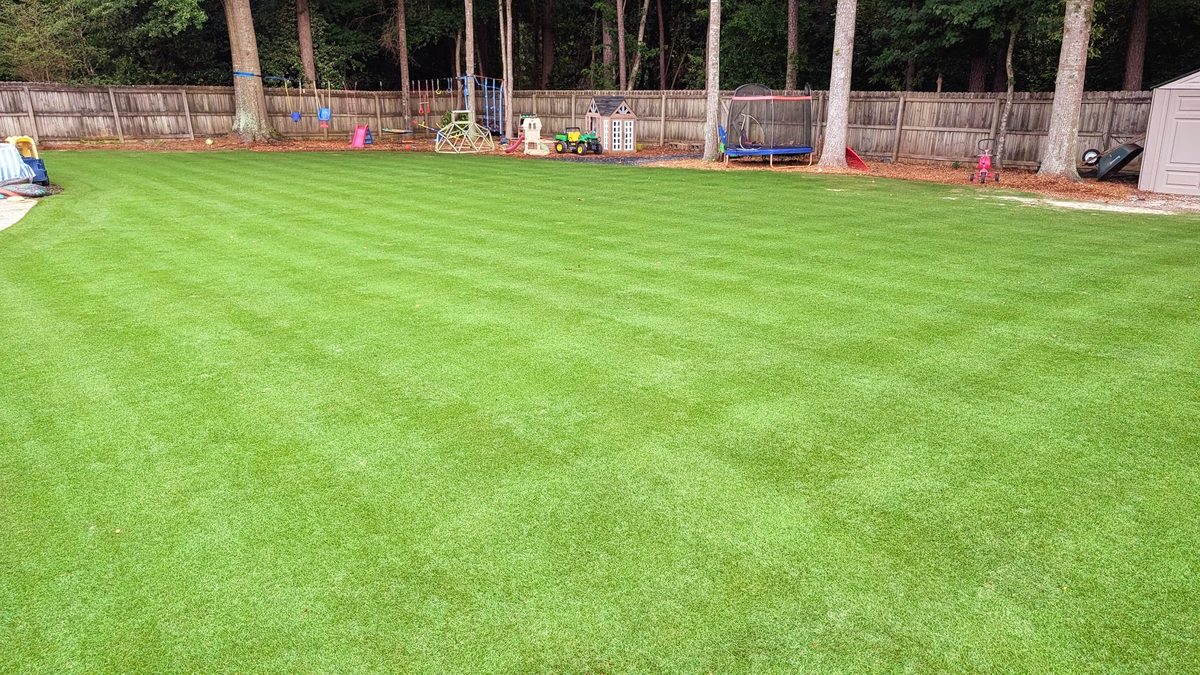
Quick Reference
| Question | Answer |
|---|---|
| Best time to topdress | May–August (lawn actively growing) |
| Max depth per pass (zoysia) | 1/4 inch |
| Right sand at big-box | Quikrete All-Purpose Sand (not Play Sand) |
| Bulk sand cost (Atlanta area) | $40–65/cubic yard delivered |
| Tool I use | 48″ double-side leveling rake (~$50) |
| Low spot deeper than 1 inch? | Step-down protocol; don’t dump it all at once |
| Topdress in fall? | No. Wait for June. |
Leveling usually leaves a few thin spots. If they don’t fill in on their own, the seeding vs. plugging guide covers the fix for your grass type.
Products Mentioned in This Article
- 48″ Double-Side Leveling Rake w/ 20 Marking Flags, Buy it
- Dremmt 30″×10″ Stainless Steel Lawn Lute, Buy it
- Gardease 30″×10″ Lawn Lute, Buy it
- Standard Golf Levelawn Pro 30″, Buy it
- Quikrete All-Purpose Sand, Home Depot / Lowe’s (no affiliate, editorial link)
This site uses affiliate links. They don’t change what I recommend. They keep the lights on here.